I'm preparing for a dog
Start with the pet-request process for your nation, then check the flat, shared route and identification records.

English guidance · United Kingdom · GB
A workable life with a dog in a UK flat starts with your nation, your housing agreement and the route from your front door. Pet-request rules differ across England, Scotland, Wales and Northern Ireland. Check permission, keep identification records current, and confirm local walking and transport conditions before building your daily routine. Northern Ireland also has its own dog-licensing and pet-travel requirements.
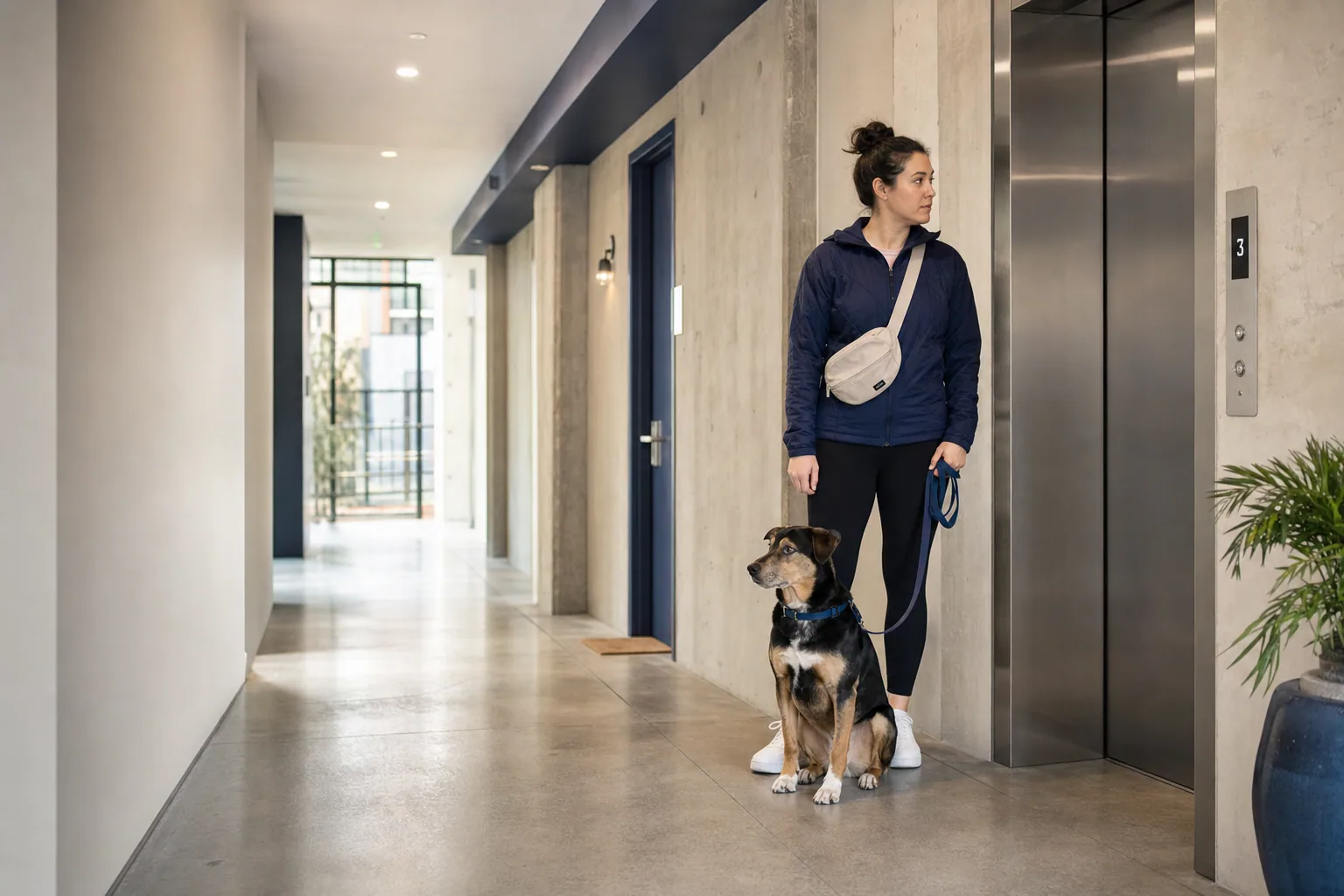
Plan the whole route: flat door, shared landing, lift or stairs, and a permitted place outside. Illustrative shared-building scene.
Start with the decision in front of you. Local-answer links stay on this page; practical methods continue in published ADL guidance or tools.
Start with the pet-request process for your nation, then check the flat, shared route and identification records.
Check whether your outdoor route, transport plan and dog records still fit your address and week.
Keep housing permission separate from travel paperwork, especially when your journey includes Northern Ireland.
Describe your dog and care plan accurately, and ask how pet requests and shared-building access are handled.
The United Kingdom includes England, Scotland, Wales and Northern Ireland. Great Britain means England, Scotland and Wales. Each fact identifies the nation or service it covers; the Republic of Ireland, Channel Islands and Isle of Man are outside this guide's scope. Each fact below keeps the authority’s finding, its scope, ADL’s explanation, and the local check separate.
For private assured tenancies covered by the current English guidance, tenants request a pet in writing with a description of the animal. The landlord must have a fair reason to refuse and normally respond in writing within 28 days. Requests for further information can extend that timetable; follow the official procedure for your case.
Scope: England, covered private assured tenancies
Limit: A request is not permission. Do not apply this process to every housing arrangement or assume a refusal or lease clause is lawful or unlawful without advice. Assistance animals need a separate assessment.
The Scottish private residential tenancy model notes require prior written landlord consent for pets. As checked on 4 September 2026, the Scottish Government says the Housing (Scotland) Act 2025 pet-request provisions have no commencement date and need further secondary legislation. The proposed new process must not be treated as already available.
Scope: Scotland, private residential tenancies
Limit: The model notes do not settle an individual contract or assistance-dog request. Recheck the reform's start date and obtain advice for the actual tenancy type.
Welsh Government guidance says landlords and contract-holders can agree additional terms about pets. It says a pet clause should allow a request for permission and that the landlord must not unreasonably refuse it. Terms must also comply with the Consumer Rights Act 2015.
Scope: Wales, occupation contracts
Limit: This does not establish blanket permission to keep a dog or import England's response deadline into Wales. A disputed term or refusal needs advice on the actual contract.
Northern Ireland's private-renting guidance says a written tenancy agreement cannot reduce a tenant's basic rights. Its separate social-housing guidance identifies pet rules as possible tenancy conditions. These sources distinguish housing arrangements and support checking the actual agreement, rather than assuming England's pet-request process applies.
Scope: Northern Ireland
Limit: The guidance does not decide whether a particular restriction is enforceable. Check your tenancy type and seek housing advice for a refusal, assistance-dog request or threatened loss of housing.
Record which nation and tenancy type apply, make the appropriate written request, and keep the response. Ask about the building's pet conditions and shared route too. A factual dog profile can explain the care plan; it cannot establish a legal entitlement.
GOV.UK says dogs in the UK must be microchipped and registered on a database by eight weeks of age. The keeper must keep the database details up to date, including after a change of address. Fitting the chip and maintaining its database record are both part of identification.
Scope: United Kingdom, dogs
Limit: Use the official guidance and your vet for exemptions or an individual dog's circumstances. A microchip record does not replace any required licence, identification tag or travel document.
Northern Ireland requires individual licensing of domestic pet dogs, subject to listed exemptions. A licence lasts 12 months and is obtained or renewed through the local council. The official guidance also requires a microchip before licensing; the licence and chip record serve different purposes.
Scope: Northern Ireland
Limit: Check the current exemptions, fees and renewal process with the district council. This Northern Ireland licensing requirement must not be presented as a UK-wide scheme.
Check the chip number, database provider and contact details when moving. If you live in Northern Ireland, check the council licence and renewal date separately. Keep accessible copies with housing consent and care contacts.
Public Spaces Protection Orders can set dog restrictions in designated public areas in England and Wales. Depending on the order, these can include leads, exclusion areas, limits on dog numbers and clean-up requirements. Councils publish where orders apply and provide notices or signs.
Scope: England and Wales, areas covered by a local order
Limit: The existence of this power does not establish the rules at a particular park, beach or street. Check the current order, map, dates, exceptions and on-site notices.
The Scottish Outdoor Access Code includes dog walking within responsible access on most land, provided the dog is under proper control. Access has exceptions, including houses and gardens, and the code asks owners to respect other people, livestock, wildlife and land management.
Scope: Scotland, land within responsible access rights
Limit: This is not permission to use every green space or residential garden, or to let a dog roam freely. Read the code and check the specific site, season and conditions.
nidirect explains the owner's responsibility to keep a dog under control. It says leads are required in designated pedestrian zones and where livestock is present, and that council byelaws identify further areas where dogs must be leashed, such as public parks. Check the council's rules for your regular destination.
Scope: Northern Ireland, with local council restrictions
Limit: Check the full control guidance and any conditions that apply to the individual dog. This summary does not establish off-lead permission or access at a particular location.
Check the council or land manager's information, walk the full route and find a permitted backup. Record access hours, lead conditions and where you can dispose of waste. Recheck the route when signs or seasonal arrangements change.
National Rail permits up to two pets per passenger free of charge, subject to its conditions. Dogs must stay on a lead or in a carrier, pets cannot use seats, and carriage can be refused if the animal causes a nuisance or inconvenience. Sleeper journeys can have additional conditions.
Scope: National Rail services in Great Britain
Limit: National Rail's policy does not establish pet access on Northern Ireland rail services, buses, coaches, ferries or international trains. Check each operator and assistance-dog arrangements separately.
TfL permits accompanied pets free of charge under its conditions, with dogs on a lead and pets off seats. Its guidance says pets must not walk on escalators and recommends lifts or stairs where possible. Staff can refuse travel if a pet is unsafe, disruptive or causes inconvenience.
Scope: Transport for London services
Limit: This is a London operator example, not a UK transport rule. Check station access and current service conditions. TfL publishes separate guidance for assistance dogs.
Confirm the policy of every operator, plan stairs or lift access around your dog's mobility, and check disruptions before leaving. Arrange a backup for time-sensitive care journeys instead of relying on one unverified connection.
A local answer becomes usable only when it fits the route through the actual building. These are the strongest intersections to plan next.
Time the trip from the flat door to a permitted toilet spot. Include the shared landing, lift wait, stairs and street crossing, then check a backup for lift outages, locked gates or changing site access.
Ask how residents use the entrance, lift, stairs and shared outdoor areas. Keep the route clear, plan where to wait when another resident or dog passes, and make the building's cleaning and contact arrangements part of the setup.
Plan where wet leads, towels and shoes go inside your flat without blocking the communal route. Check the lighting on early or late trips and make sure a caregiver can use the same permitted route when your schedule changes.
Entry documentation is a separate official task from finding and setting up the apartment.
For entry into Great Britain, GOV.UK sets origin-dependent requirements for microchipping, rabies vaccination, travel documents, routes and, where applicable, dog tapeworm treatment. Northern Ireland uses separate DAERA guidance. For eligible direct journeys from Great Britain, GB residents can use the Northern Ireland Pet Travel Scheme with a microchip, a free Pet Travel Document and a declaration against onward EU travel. NI residents returning directly from GB have different arrangements. Travel via or onward to the Republic of Ireland or another EU country needs the relevant EU-route checks.
Scope: Great Britain and Northern Ireland, depending on origin, residence and route
Limit: This is not a complete entry checklist. Ask the authority and your vet about timing, permanent moves, non-UK residents, rehoming, commercial movements, restricted dogs and the exact journey before booking.
Use the local answer above, then choose the published ADL route that matches the apartment problem you need to solve.
Use a factual dog profile and practical setup checklist alongside the correct local permission process.
Turn the permitted destination into a repeatable route through your actual building.
Fit walks, rest, work and care support around your flat and the services you can use.
Bring together housing consent, updated records, arrival logistics and the first route outside.
The United Kingdom includes England, Scotland, Wales and Northern Ireland. Great Britain means England, Scotland and Wales. Each fact identifies the nation or service it covers; the Republic of Ireland, Channel Islands and Isle of Man are outside this guide's scope.
This is source-linked orientation, not an assessment of your legal rights or veterinary needs. Tenancy type, assistance-dog rights, restricted dogs, disputes and individual travel eligibility need their own checks with the relevant authority or qualified adviser.
The official sources have different territorial scopes: the English pet-request process covers specified English tenancies, Scottish housing reforms have their own implementation timetable, and Northern Ireland operates a dog-licensing system. Operator pet policies add another layer. One nation's or service's guidance cannot establish the answer for the whole UK.
Limit: This guide is selective orientation for apartment life. It is not a complete account of UK dog law, housing rights, assistance-dog access or transport and entry conditions.
Choose the questions that matter now. The Starter Plan orders the published apartment, toilet, routine, moving, rental, and tool routes around them.