I’m preparing for a dog
Check housing permission and find the registration and tax process for your municipality before the dog arrives.

English guidance · Germany · DE
Living with a dog in a German apartment combines the lease and building with municipal administration, rules made by a federal state (Land) or city, and the policies of each transport network you use. The details are not uniform across Germany, so start by identifying which authority controls the question, verify the rule for your address or route, and then adapt your apartment plan.
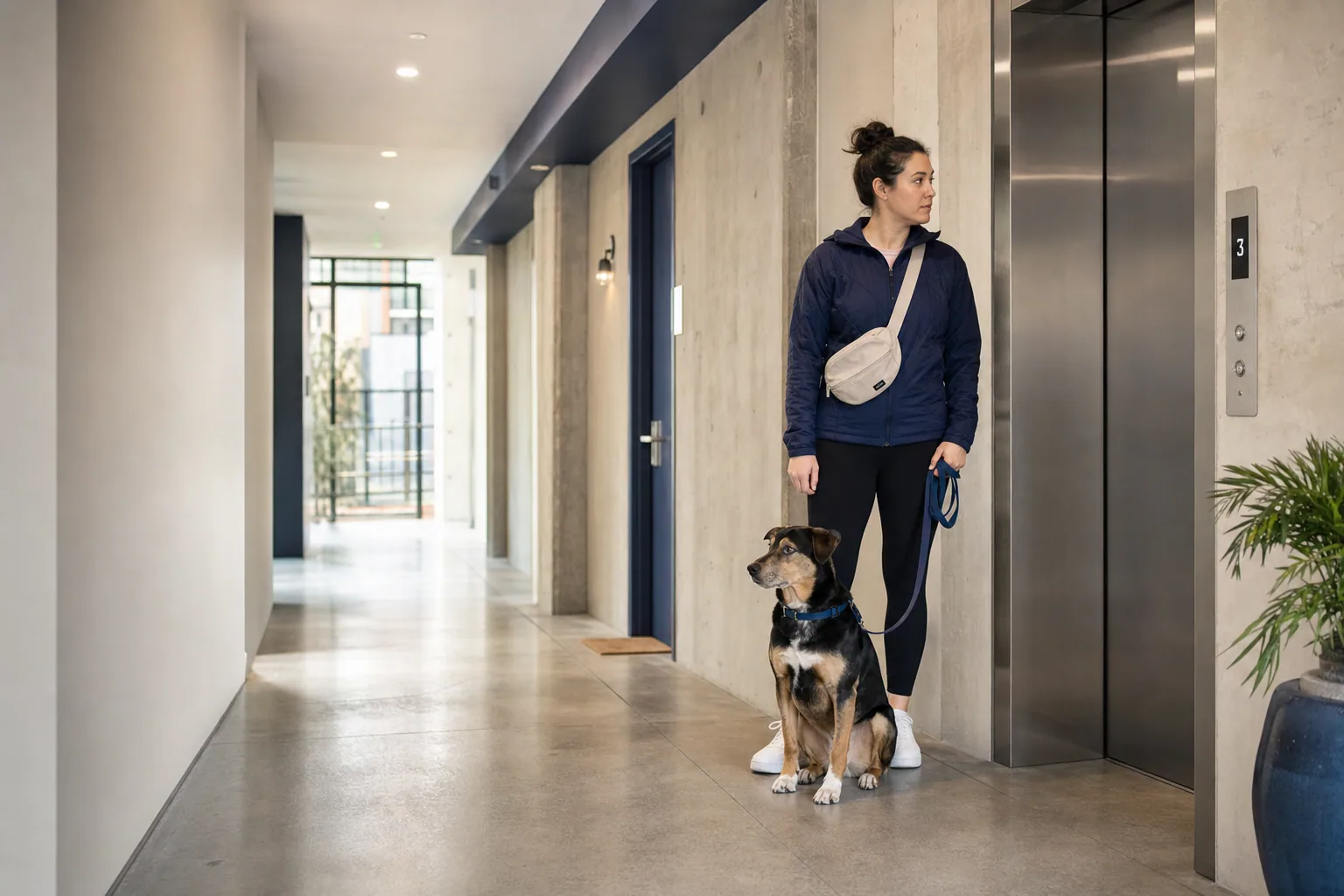
The practical plan joins the applicable local rule to the route from the apartment door to the street.
Start with the decision in front of you. Local-answer links stay on this page; practical methods continue in published ADL guidance or tools.
Check housing permission and find the registration and tax process for your municipality before the dog arrives.
Check whether the local authority, public-space route, or transport operator changes the plan you already use.
Separate entry documentation from the apartment move and the destination municipality’s administration.
Start with the Germany rental fact, then check the complete lease, written building rules, and any individual approval.
Join the locally permitted destination to the full lift, stair, door, and street route.
Build the day around the real building exit, local walking options, transport, work, and available support.
This page gives Germany-wide orientation and uses current official examples from Berlin and Munich to show where local answers differ. Verify the actual Land, municipality, operator, lease, and building. Each fact below keeps the authority’s finding, its scope, ADL’s explanation, and the local check separate.
In judgment VIII ZR 168/12, Germany’s Federal Court of Justice held that a standard-form residential lease term requiring tenants to keep no dogs or cats was invalid. The decision requires the relevant interests in the individual case to be considered rather than treating that clause as an automatic answer.
Scope: Germany
Limit: The judgment does not create an unconditional right to keep any dog in every rented home. The lease, individual permission, building circumstances, and specific facts still matter.
Read the full lease, identify any approval process, ask precise questions, keep written records, and describe the dog factually rather than promising an outcome.
Germany’s Federal Ministry of Finance classifies Hundesteuer as a local tax levied by cities and municipalities. Whether and how it is levied must be checked with the relevant local administration or Land finance authority.
Scope: Germany, implemented locally
Limit: This page intentionally gives no nationwide rate. Amounts, classifications, exemptions, deadlines, and administrative steps can change locally.
Berlin requires permanent dog keepers to use its central dog register and, since 1 January 2024, registration there also acts as tax registration. Munich’s official service instead tells people taking in a dog or moving to Munich with one to register it for dog tax within two weeks.
Scope: Berlin and Munich examples
Limit: These examples prove local variation; they are not a directory of every German registration process.
Check the destination municipality before the move, save the official instructions, and add the local deadline and documents to the moving checklist.
Berlin’s official dog-law guidance requires liability insurance covering personal injury and property damage for dogs in Berlin and states minimum coverage and excess limits.
Scope: Berlin
Limit: Berlin’s requirement must not be presented as a single rule for all Germany. Check the current law and official guidance for the Land where the dog is kept or taken.
Check the competent Land authority and the policy terms, then keep the evidence with the dog’s other housing and travel documents.
Berlin describes a general leash requirement across the city, subject to stated exceptions and designated off-leash areas. Munich says there is no general leash requirement for all dogs citywide, but lists specific areas and categories where access or leash rules apply.
Scope: Berlin and Munich examples
Limit: Rules may also depend on the dog, location, park owner, protected area, event, or a specific order. Verify the actual route and destination.
Check the municipality and destination owner, then map a primary route and a workable backup before relying on either.
Deutsche Bahn currently allows small pets in a suitable closed carrier without charge and generally charges half the adult fare for a larger dog, with leash and muzzle requirements outside a carrier. MVV currently allows one dog to travel without an additional fare with a valid MVV ticket or Deutschlandticket, while applying its own conditions.
Scope: Deutsche Bahn and MVV examples
Limit: Local networks, regional products, international services, assistance dogs, multiple dogs, and individual operators can have different conditions.
Check every operator on the journey, carry the required equipment, and keep a non-transit backup for time-sensitive care where possible.
A local answer becomes usable only when it fits the route through the actual building. These are the strongest intersections to plan next.
Once local rules identify a permitted destination, the real German apartment plan still has to cover corridors, the lift or stairs, doors, and the final distance outside. Measure that route and keep a backup for lift outages or access changes.
Lease and building rules can affect entrances, corridors, lifts, courtyards, and cleaning. Record those requirements separately from municipal law, then plan a calm, repeatable route through the building.
Entry documentation is a separate official task from finding and setting up the apartment.
Federal guidance explains that requirements for non-commercial entry with a dog depend on the origin country and can include identification, rabies documentation, an EU pet passport or health certificate, and additional steps for certain non-EU origins.
Scope: Germany and the European Union
Limit: Origin, route, purpose, number of animals, and current disease-control rules can change the requirements. Use the official checker and competent authority for the actual move.
Use the local answer above, then choose the published ADL route that matches the apartment problem you need to solve.
Keep dog transport, arrival, handoffs, and the first route outside visible during the move.
Prepare factual rental information and the apartment’s rooms, records, and building route.
Turn a permitted local destination into a workable high-rise route and record what happens.
Build the week around the actual building route, local walking options, transport, work, and support.
This page gives Germany-wide orientation and uses current official examples from Berlin and Munich to show where local answers differ. Verify the actual Land, municipality, operator, lease, and building.
This page is practical orientation, not legal advice. Official local services, the current lease, written building rules, and qualified advice control individual cases.
Current official sources show different registration and tax workflows in Berlin and Munich, different public-space rules in those cities, and different dog-carriage conditions between Deutsche Bahn and MVV. A source must therefore name the authority and geographic or operator scope it actually covers.
Limit: The examples demonstrate why scope matters. They do not describe every German Land, municipality, park, transport operator, lease, or building.
Choose the questions that matter now. The Starter Plan orders the published apartment, toilet, routine, moving, rental, and tool routes around them.