
Puppy potty training
How to Potty Train a Puppy in an Apartment
Help your puppy learn where to go, even when getting outside takes more than opening the back door.
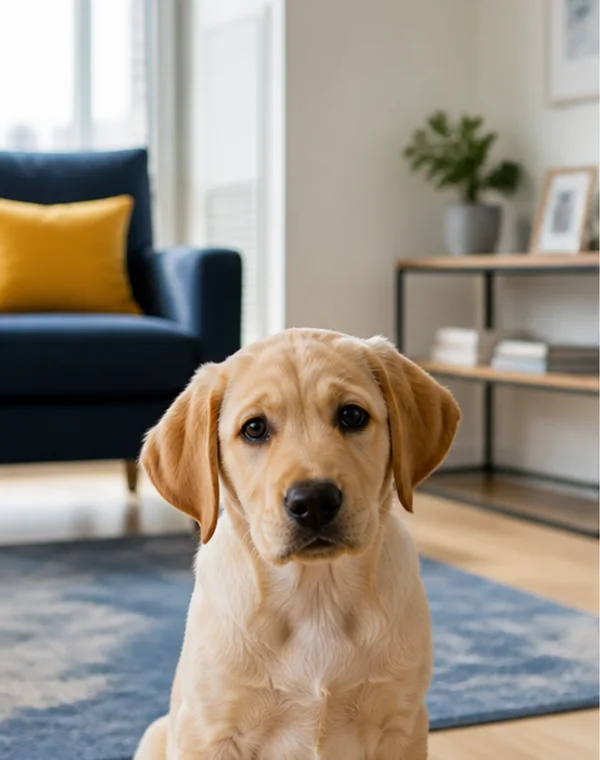
Short answer
Yes, you can potty train a puppy in an apartment.
Potty training a puppy in an apartment works best when toilet learning and the route outside are planned together. Keep the route ready, offer toilet opportunities at predictable moments, move promptly through the building, reward your puppy immediately after toileting in the intended place, supervise indoors, and treat accidents as information that the timing, route, or setup needs adjusting.
What changes because your puppy lives in an apartment?
The learning principles stay the same. The apartment adds a route between noticing the need and reaching the toilet area, and every stage can add delay. Your plan needs to make that route easier to complete.
- Notice a likely need
- Attach leash or harness
- Apartment door
- Corridor
- Lift or stairs
- Lobby and exit
- Toilet area
Remove avoidable delay
- Keep shoes, keys, waste bags, and rewards in one ready place.
- Use a leash or harness setup you can put on promptly and safely.
- Keep the exit path clear and know which shared door slows you down.
- Choose the intended toilet area before the trip begins.
Know the backup
Decide what happens if the lift is slow, the ordinary exit is unavailable, weather blocks the normal area, or the regular caregiver cannot make the trip. A backup is useful only when it is permitted, safe, reachable, and understood by everyone who helps.
If the route itself is the main problem, use the high-rise potty route plan for a more detailed building check.
A clear, repeatable apartment routine
Use the same six-part loop throughout the day. It connects the puppy’s learning with the building logistics you can control.
- 01
Notice
Watch for likely toilet moments and your puppy’s own signals. Do not wait for a signal when the recent pattern suggests an earlier opportunity.
- 02
Prepare
Keep the leash or harness, rewards, waste bags, shoes, keys, and chosen route ready before they are needed.
- 03
Go
Move promptly and calmly through the apartment, shared building, and final outdoor stretch to the intended toilet area.
- 04
- 05
Observe
Record the trigger, route time, location, outcome, and any delay as facts, without labeling the puppy stubborn or spiteful.
- 06
Adjust
Change one workable variable, such as offering an earlier opportunity, staging equipment, or using a clearer backup route.
When should you take a puppy outside?
Offer toilet opportunities at high-probability moments: after waking, meals, play, rest, exercise, or excitement; before an absence; after returning; and whenever your puppy shows an individual signal. Common signals can include a sudden pause, focused sniffing, circling, pacing, or moving toward an exit.[3][4][5]
For a puppy whose vaccination plan or local disease risk makes shared outdoor space uncertain, ask your veterinarian which locations are appropriate. Apartment living alone cannot answer that question.[8]
What should you do when your puppy toilets outside?
Stay close enough to see when your puppy finishes, then reward immediately in the intended toilet area. A reward given only after returning to the apartment may reinforce coming indoors instead of the toilet action. Use a short, consistent cue only as toileting begins, and keep the response calm and predictable.[1][2][3]
What should you do after an accident?
Clean it calmly and review what happened before it. Punishment does not teach the intended toilet location and can make a puppy avoid toileting in front of people. If you notice toileting beginning, interrupt only if you can do so calmly and move safely to the intended place.[1][3][4]
- Timing
- Was the opportunity offered too late after a likely trigger?
- Supervision
- Was the puppy out of view when a need was easy to miss?
- Route
- Did equipment, a door, stairs, a lift, or the lobby add avoidable delay?
- Environment
- Was the chosen location unavailable, unfamiliar, unsafe, or too difficult to reach?
- Coverage
- Did a work period or caregiver handoff leave no realistic opportunity?
What changes in your apartment situation?
Keep the learning loop consistent, then adapt the route, preparation, and coverage to the constraint that is actually present.
- Very young puppy
- Plan more opportunities and assume there may be little margin for a slow route. Use your puppy’s observed pattern and veterinary guidance, not an age-to-hours formula.
- High-rise
- Include lift wait, corridor traffic, security doors, the lobby, and the final outdoor distance. Name a safe fallback for lift or access disruption.
- Walk-up
- Make the stair route safe and manageable for both of you. If carrying is being considered, get individual guidance where size, mobility, or handling safety is uncertain.
- No balcony
- A balcony is not required. Choose a permitted outdoor area you can reach consistently, or compare a clearly defined indoor backup if access is genuinely unreliable.
- Bad weather
- Keep equipment by the door and use a repeatable route to a suitable area. Weather changes the logistics, not the need for a clear location and consistent response.
- Single owner
- Reduce setup steps and identify who can cover a toilet opportunity when you cannot. A backup person needs the same route, location, cue, and reward plan.
- Busy or work schedule
- Plan coverage around the puppy’s current observed needs. A pad, pen, or crate does not replace suitable toilet opportunities or responsible care coverage.
- Overnight
- Stage everything before bed, keep the trip quiet and direct, and use the fastest safe route. Share responsibility where possible.
Are puppy pads or an indoor toilet necessary?
Not for every apartment. Some owners consider an indoor or backup option because the route outside is unreliable, a permitted destination is temporarily unavailable, or a professional plan calls for a different setup. Whatever you choose, use one clear primary location and define when a backup applies so the household can respond consistently.
The tradeoffs include access, hygiene, containment, maintenance, building rules, cost, and any later transition. Use the indoor or outdoor toilet-options guide to make that decision. A balcony is not automatically safe, suitable, or permitted.
How do you know the routine is working?
Look for a direction of travel rather than a promised completion date.
- More trips end at the intended toilet area.
- Accidents become less frequent over time.
- You can anticipate more of the puppy’s likely toilet moments.
- The building route becomes calmer and easier to prepare.
- Fewer attempts fail because of avoidable access delay.
- The daily pattern feels more predictable for the people responsible.
Continue with the complete system
Use ADL’s complete apartment potty-training method
This page solves the puppy-specific apartment situation. The broader method brings timing, supervision, reinforcement, toilet-location decisions, accidents, route planning, and troubleshooting together in one connected system.
Open the complete potty-training methodMake the route easier to understand
The Potty Route & Toilet Log maps each building segment and records factual events in your browser. It can help you compare route friction and later observations without diagnosing a cause or sending raw entries to ADL.
Evidence record
Sources, scope, and review
This page reuses the published evidence behind ADL’s apartment potty-training system. Apartment route mechanics are an ADL living-logistics explanation built around those reward-based learning and welfare boundaries.
- Housetraining TipsAmerican Veterinary Society of Animal BehaviorVeterinary behavior society guidance. Accessed July 28, 2026.
- Humane Dog Training Position StatementAmerican Veterinary Society of Animal BehaviorVeterinary behavior society position statement. Accessed July 28, 2026.
- How to Toilet Train Your Puppy or DogRSPCAAnimal welfare organization guidance. Accessed July 28, 2026.
- Toilet Training a PuppyBlue CrossAnimal welfare organization guidance. Accessed July 28, 2026.
- What to Do When You First Bring Home a New PuppyAmerican Animal Hospital AssociationVeterinary association guidance. Accessed July 28, 2026.
- Behavior Problems of Dogs: House SoilingMerck Veterinary ManualPeer-reviewed veterinary manual. Accessed July 28, 2026.
- When to See a VeterinarianMerck Veterinary ManualPeer-reviewed veterinary manual. Accessed July 28, 2026.
- Canine ParvovirusAmerican Veterinary Medical AssociationVeterinary association client guidance. Accessed July 28, 2026.
- Author
- Apartment Dog Living editorial team
- Editor
- Apartment Dog Living editorial team
- Reviewer status
- Editorial and welfare-safety check complete; no veterinary or qualified behavior review claimed.
- Scope
- General reward-based toilet-learning and apartment-logistics guidance. It does not prescribe a universal holding interval, decide which shared outdoor area is suitable for an individual puppy, or replace veterinary or qualified behavior advice.
- Published
- October 2, 2026
- Editorially checked
- October 2, 2026
- Updated
- October 2, 2026
- Next review
- April 2, 2027
- Corrections
- Review the current correction process in the trust center.